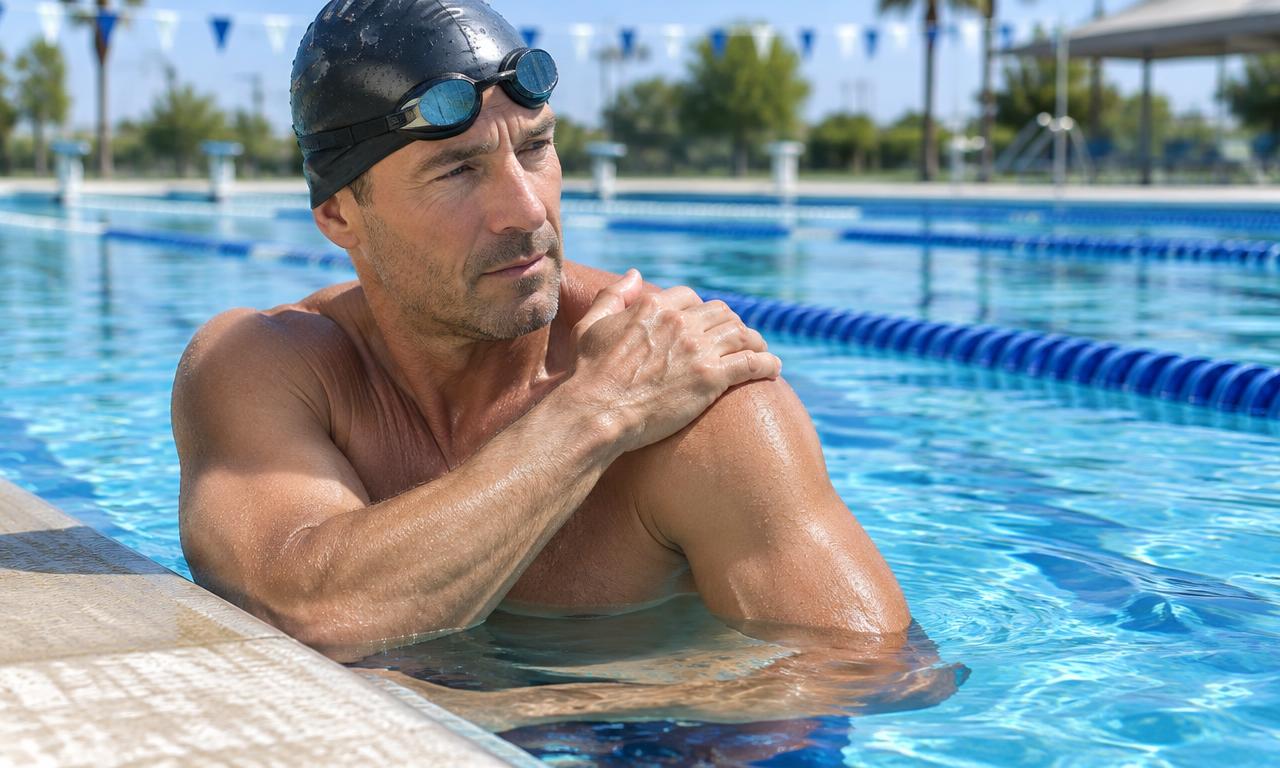
Swimmer's shoulder is an overuse pattern driven by the specific demands of swimming. Treatment that addresses the shoulder in isolation often misses the full picture.
The masters swimmer walks in with shoulder pain that's persisted for six months. She trains three times a week and has been told she has swimmer's shoulder. Physical therapy helped somewhat but the pain hasn't fully resolved. She's wondering if she needs to stop swimming.
Swimmer's shoulder — essentially an overuse syndrome of the shoulder in swimmers — is common and typically responds well to comprehensive treatment. Stopping swimming is usually not necessary.
What swimmer's shoulder actually involves
The term "swimmer's shoulder" describes a cluster of related conditions produced by the specific demands of swimming:
Rotator cuff tendinopathy — chronic loading of the rotator cuff tendons, particularly the supraspinatus, from thousands of overhead cycles.
Subacromial impingement — compression of the rotator cuff and bursa under the acromion during overhead motion.
Biceps tendinopathy — the long head of the biceps tendon gets loaded repetitively during the pull phase.
Labral pathology — chronic microtrauma can produce labral changes in advanced cases.
Many swimmer's shoulder cases involve more than one of these components simultaneously, which is why treatment focused on one aspect alone often leaves residual symptoms.
The mechanical drivers
Swimming produces unique shoulder demands:
High volume. A masters swimmer doing moderate training may perform 3,000 to 6,000 arm cycles per session. Over weeks and years, this cumulative loading far exceeds what most adults' shoulders have been prepared for.
Repetitive overhead motion. The recovery phase of every stroke brings the arm into overhead positions that load the vulnerable rotator cuff structures.
Internal rotation at the catch. The initial pull involves internal rotation that can impinge the supraspinatus.
Trunk and core contributions. Swimmers with inadequate trunk and core stability compensate at the shoulder.
Breathing patterns. Asymmetric breathing patterns produce asymmetric shoulder loading.
Previous training history. Masters swimmers who swam competitively in youth bring different wear patterns than adult-onset swimmers.
Why isolated shoulder treatment often fails
Standard physical therapy for swimmer's shoulder typically focuses on rotator cuff strengthening and scapular stability. Both are important and appropriate. But they often don't address:
- The thoracic spine mobility that determines shoulder mechanics
- The cervical spine contributions to shoulder dysfunction
- The trunk and core contributions to shoulder loading
- The specific stroke mechanics producing the pathology
- The rate and progression of return to swimming
Patients who complete isolated shoulder PT often return to swimming with partial improvement, only to redevelop symptoms as volume increases.
The comprehensive approach
Effective treatment for chronic swimmer's shoulder addresses multiple contributors:
Shockwave therapy for chronic rotator cuff tendinopathy. See Rotator Cuff Tendinopathy: When Shockwave Therapy Is the Answer for the full context on shockwave for this condition.
Dry needling of rotator cuff, upper trapezius, levator scapulae, pectoralis minor, and other musculature contributing to pain patterns and dysfunctional mechanics.
Chiropractic manipulation of the thoracic spine, cervical spine, and ribs. Thoracic mobility is often the limiting factor that forces the shoulder into compromised positions.
Progressive rotator cuff rebuilding. Not generic rotator cuff exercises — specific progressive loading designed to rebuild the capacity the swimming is asking for.
Scapular stability work. The scapular stabilizers (serratus anterior, middle and lower trapezius) are often the weak link.
Trunk and core stability. Builds the foundation that unloads the shoulder.
Stroke technique assessment and modification. Specific technique changes can significantly reduce shoulder loading.
Training volume and progression management. Return to full volume is gradual and guided by tissue response.
Modifications during treatment
Most swimmers can continue swimming during treatment with appropriate modifications:
- Reduced volume (50-70% of normal)
- Modified stroke selection (backstroke often less provocative than freestyle)
- Breathing pattern changes
- Pulls with buoy or kick sets to reduce arm loading
- Stroke technique modifications
Complete cessation of swimming is rarely needed and can produce deconditioning that makes return harder.
Timeline
Chronic swimmer's shoulder typically responds to comprehensive treatment within 8 to 16 weeks. Return to full training volume usually takes 3 to 4 months from starting treatment.
Frequently Asked Questions
- Do I need an MRI?
- Clinical examination is usually sufficient for initial treatment planning. MRI may be useful in cases that don't respond to treatment or when specific structural concerns are present.
- Will I need to change my stroke?
- Modifications are often helpful during treatment and sometimes beneficial long-term. Significant stroke overhaul is rarely necessary — small technique changes often produce substantial loading reductions.
- Can older swimmers develop this?
- Yes. Masters swimmers of any age can develop swimmer's shoulder, and older swimmers may be more vulnerable due to age-related tissue changes.
- Should I take anti-inflammatories?
- Short-term use can help with acute flares. Long-term NSAID use may impair healing and isn't typically recommended for chronic tendinopathy.
If chronic shoulder pain has limited your swimming, schedule a consultation at Stryde Health and Performance in Boynton Beach. We treat chronic shoulder conditions in Palm Beach County's masters swimmers and other overhead athletes with comprehensive combined approaches.