Dry needling addresses muscle pain in ways that massage, stretching, and general therapy often can't. Here's what actually happens during treatment and what to expect.
Chronic muscle pain — that persistent tight, achy pattern that doesn't fully resolve with stretching, foam rolling, or massage — is often driven by myofascial trigger points. These are hyperirritable spots in taut bands of skeletal muscle that produce local and referred pain patterns.
Dry needling is one of the most effective interventions for treating trigger points directly. At Stryde Health and Performance, it's a modality we use routinely for patients with chronic muscle pain that hasn't resolved with other approaches.
Here's what to expect from treatment.
What dry needling actually is
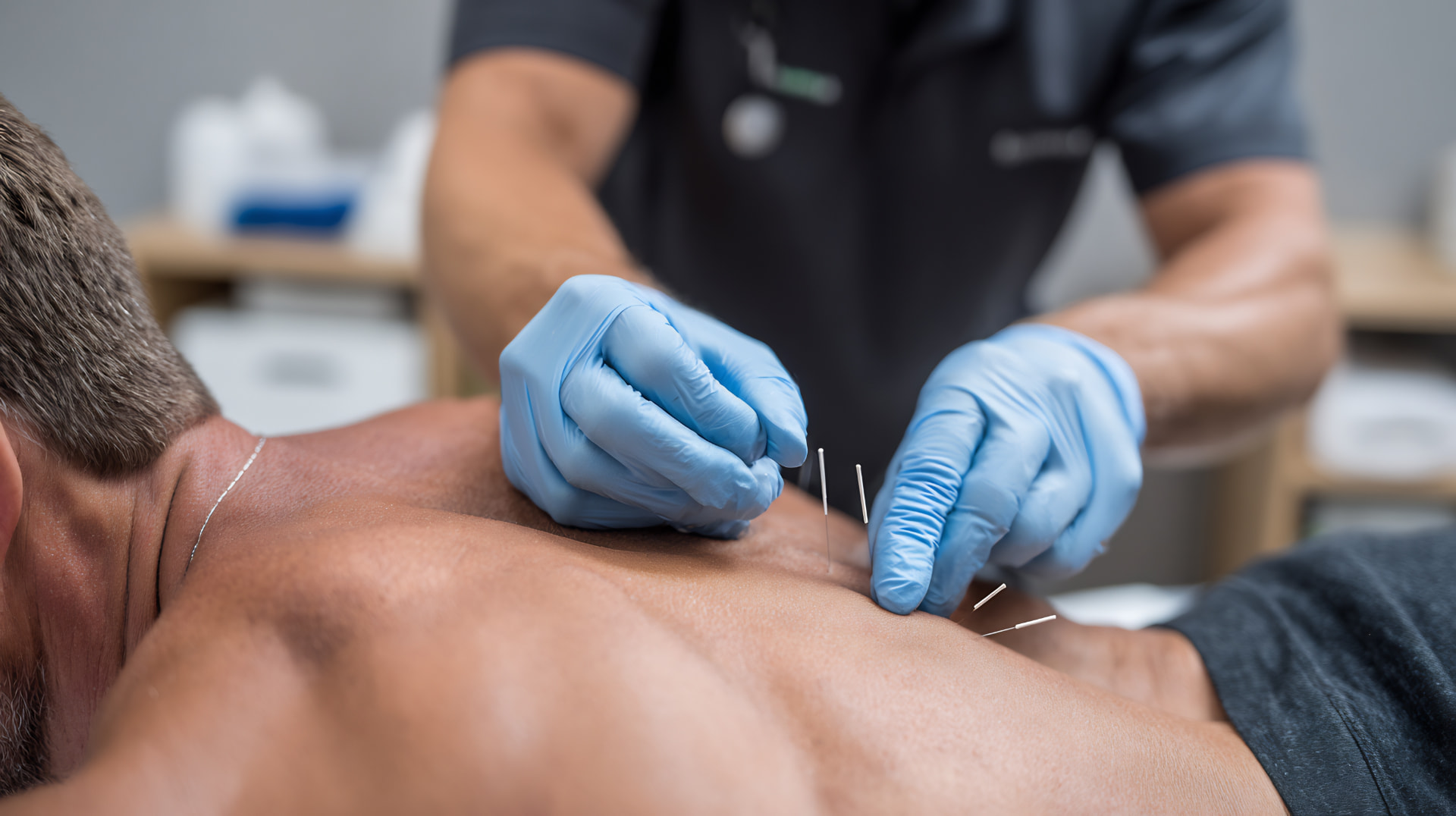
Dry needling uses thin, solid, filiform needles — similar in appearance to acupuncture needles but used within a Western musculoskeletal framework. The needle is inserted through the skin directly into the trigger point or dysfunctional muscle tissue.
The term "dry" distinguishes it from injections that use hollow needles to deliver medication ("wet" needling). Dry needling doesn't introduce any substance into the tissue — the needle itself is the intervention.
When placed correctly in a trigger point, the needle often produces a local twitch response — a brief involuntary muscle contraction that's the therapeutic target. The twitch is associated with reduction in trigger point activity, decreased pain, and improved muscle function.
What the treatment feels like
The needle insertion is typically felt as a brief pinch. Once the needle is in the muscle and reaches the trigger point, patients usually feel a deeper aching sensation — sometimes described as a "good hurt" — and often feel the local twitch response as a quick cramping sensation.
The needle stays in place briefly (usually seconds to a couple of minutes) or is manipulated to elicit multiple twitch responses. Then it's withdrawn and the process may be repeated at other trigger points.
Most patients describe the experience as uncomfortable but tolerable. It's more intense than acupuncture but not what most people would describe as painful. Patients with needle anxiety often tolerate it well once they experience it.
What happens afterward
Post-treatment soreness is common and expected. It typically resembles the soreness after intense exercise — a dull ache in the treated muscles lasting 24 to 48 hours.
Some patients feel immediately better after treatment. Others feel worse for a day before feeling better. Both patterns are normal.
Common side effects include:
- Post-treatment muscle soreness (24-48 hours)
- Minor bruising at needle sites
- Brief lightheadedness in some patients
- Temporary fatigue
Serious side effects are rare when performed by properly trained clinicians.
Conditions where dry needling is particularly effective
Dry needling has strong evidence for:
Chronic myofascial pain syndrome. Neck and upper back pain patterns driven by trigger points.
Tension-type headaches. Trigger points in the suboccipital and cervical musculature.
Chronic muscle tension in athletes and desk workers.
Certain tendinopathies where surrounding musculature contributes to pain patterns.
Post-exercise recovery in cases of chronic muscle dysfunction.
Complex regional pain in some cases.
For active adults in Palm Beach County — golfers, tennis players, pickleball players, cyclists — dry needling frequently helps with:
- Chronic upper trapezius and neck tension
- Piriformis and gluteal trigger points in cyclists
- Forearm and rotator cuff tension in racquet sports
- Calf and hamstring dysfunction in runners and cyclists
How dry needling fits into treatment plans
Dry needling is typically used as part of a comprehensive treatment plan rather than as a standalone intervention. At Stryde, it's integrated with:
- Chiropractic manipulation
- Rehabilitation exercise
- Shockwave therapy in appropriate cases
- Movement pattern retraining
- Home care and lifestyle modifications
Standalone dry needling can provide temporary relief but rarely resolves chronic problems without addressing the underlying loading patterns and functional contributors.
How many sessions do most patients need
Response varies by condition:
Acute muscle issues often resolve in 2 to 4 sessions.
Chronic tension patterns typically require 6 to 10 sessions before meaningful change is established.
Post-injury or post-surgical cases may benefit from ongoing intermittent treatment during recovery.
Session frequency is typically weekly to twice-weekly during active treatment phases, decreasing as improvement is established.
Who is not a good candidate
Dry needling is generally not appropriate for patients with:
- Bleeding disorders or on blood-thinning medications (relative contraindication)
- Active local infection at treatment area
- Certain immunocompromised states
- Severe needle phobia
- Pregnancy (some restrictions)
- Certain lymph-related conditions
Clinical evaluation determines candidacy.
Frequently Asked Questions
- Is dry needling the same as acupuncture?
- No. Both use thin needles but work within different frameworks. Dry needling is based on Western musculoskeletal anatomy and treats trigger points and muscle dysfunction directly. Acupuncture is based on Traditional Chinese Medicine meridian theory. See Dry Needling vs. Acupuncture for detailed comparison.
- Does dry needling hurt more than acupuncture?
- Generally yes. Acupuncture uses gentle needle placement at meridian points and typically produces minimal sensation. Dry needling directly targets dysfunctional muscle tissue and often produces a stronger sensation, particularly when eliciting the local twitch response.
- Is dry needling safe?
- When performed by properly trained clinicians, dry needling has an excellent safety profile. Adverse events are rare. Common minor side effects (soreness, bruising) resolve within days.
- Who can perform dry needling in Florida?
- In Florida, dry needling is within the scope of practice for appropriately trained chiropractors and physical therapists. Certification through recognized training programs is expected. Verify credentials before treatment.
If chronic muscle pain has limited your activity and other treatments haven't fully resolved it, schedule a consultation at Stryde Health and Performance in Boynton Beach. Dry needling is one of the routine modalities we integrate into treatment plans for chronic musculoskeletal pain in active adults.