Running gait analysis has become a common offering in sports clinics. What it actually finds — and how to use the findings — matters more than whether you do it.
Running gait analysis has become a standard offering at many sports medicine clinics, running specialty stores, and physical therapy practices. The quality and usefulness of the analysis varies enormously. Here's what a good gait analysis actually reveals, when it's worth doing, and how to use the findings.
What running gait analysis actually examines
A comprehensive gait analysis assesses multiple aspects of your running mechanics:
Foot strike pattern — heel, midfoot, or forefoot. Each has advantages and considerations.
Cadence — steps per minute. Most recreational runners run at lower cadences than optimal.
Hip drop (pelvic stability) — whether the pelvis drops on the swing leg side during stance. Indicates gluteal weakness.
Knee position at loading — whether the knee falls inward (valgus) during initial contact, suggesting hip control deficits.
Overstriding — whether the foot lands well in front of the body's center of mass, which increases impact forces.
Trunk position — forward lean, rotation, and postural control through the gait cycle.
Arm swing — symmetry and mechanics of upper body involvement.
Push-off mechanics — quality of the propulsive phase, hip extension at toe-off.
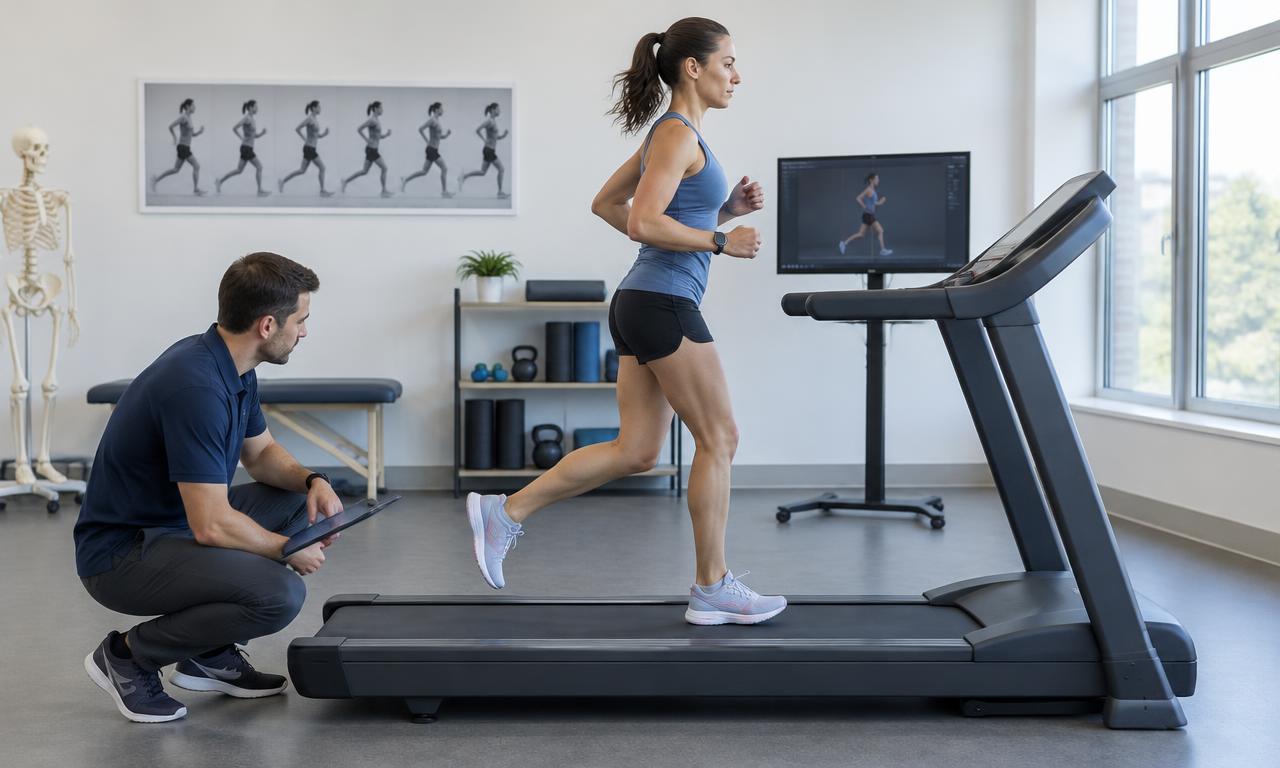
Good gait analysis examines all of these at multiple speeds, often with slow-motion video review.
Common findings and what they mean
Low cadence (below 170 steps per minute) is common in recreational runners. Increasing cadence by 5-10% typically reduces overstriding, loading rate, and injury risk. Often the single most impactful change.
Hip drop suggests gluteus medius weakness. Common in runners with IT band syndrome, runner's knee, and lower back pain. Addressable through specific hip strengthening.
Overstriding increases impact forces and is often associated with injury. Usually resolves with increased cadence and attention to foot landing position.
Knee valgus (knee falling in) suggests hip control deficits and sometimes foot pronation contributions. Addressable through strengthening and sometimes orthotic support.
Asymmetric mechanics suggests underlying injury compensation or structural asymmetry that warrants investigation.
Excessive vertical oscillation (bouncing up and down) wastes energy and increases impact forces. Addressable through cadence and technique work.
When gait analysis is worth doing
Gait analysis is most valuable for:
- Runners with recurrent injuries without clear mechanical cause
- Runners who want to improve efficiency and performance
- Runners returning from injury who want to identify contributing factors
- New runners who want to establish good mechanics early
- Runners planning significant training increases
Less essential for:
- Comfortable, injury-free runners meeting their goals
- Runners whose issues clearly relate to training errors rather than mechanics
- Casual runners without injury or performance concerns
What distinguishes good gait analysis
Not all gait analyses are equal. Good analysis includes:
Multiple perspectives. Side, back, and front views — not just one angle.
Multiple speeds. Your mechanics at easy pace differ from tempo pace. Both matter.
Slow-motion review. Real-time observation misses important details. Video that can be slowed and analyzed catches more.
Clinical context. Mechanics are interpreted in light of your running history, goals, injury patterns, and other assessment findings.
Actionable recommendations. The analysis produces specific changes to work on — not just descriptions of what you do.
Follow-up and reassessment. Changes to gait take time to implement. Follow-up assessment confirms the changes are happening as intended.
Avoid gait analyses that are brief, use a single camera angle, don't include slow-motion review, or deliver generic recommendations.
How findings become changes
Gait changes don't happen instantly. Research on gait retraining suggests that:
- Attention and feedback are required for initial change
- Specific drills and cues help internalize new patterns
- 4-12 weeks of consistent practice typically produces durable change
- The changes feel awkward initially before becoming automatic
Cadence changes are often easiest — using a metronome or music with appropriate BPM provides direct feedback.
Hip and knee mechanics require strengthening work alongside form cues to make durable change.
Overstriding and foot strike changes usually involve multiple cues working together.
Integration with treatment
For runners dealing with injuries, gait analysis integrates with the broader treatment plan. Mechanical findings inform what strengthening work matters most, what shockwave or dry needling targets to prioritize, and what return-to-running progression makes sense.
Gait analysis without integration into comprehensive care is often less valuable than when it's part of a full assessment.
Frequently Asked Questions
- Is gait analysis necessary for every runner?
- No. Many runners do well without it. It's most valuable for specific situations — injury patterns, performance interest, return from injury.
- Can I do gait analysis myself with my phone?
- Self-analysis with video is better than nothing. You'll miss some things that trained observers catch, but recording yourself from side and back during running provides useful information.
- How often should I repeat gait analysis?
- Once initial changes are implemented, reassessment at 3-6 months confirms progress. Ongoing reassessment every year or two makes sense for serious runners.
- Will I run faster with better mechanics?
- Often yes, but the primary benefit is injury prevention and efficiency rather than pure speed. Significant time improvements come from training and fitness; mechanics support the capacity to train consistently.
If recurrent injury patterns or performance questions suggest gait analysis would help, schedule a consultation at Stryde Health and Performance in Boynton Beach. We integrate running gait assessment into comprehensive care for Palm Beach County's running community.