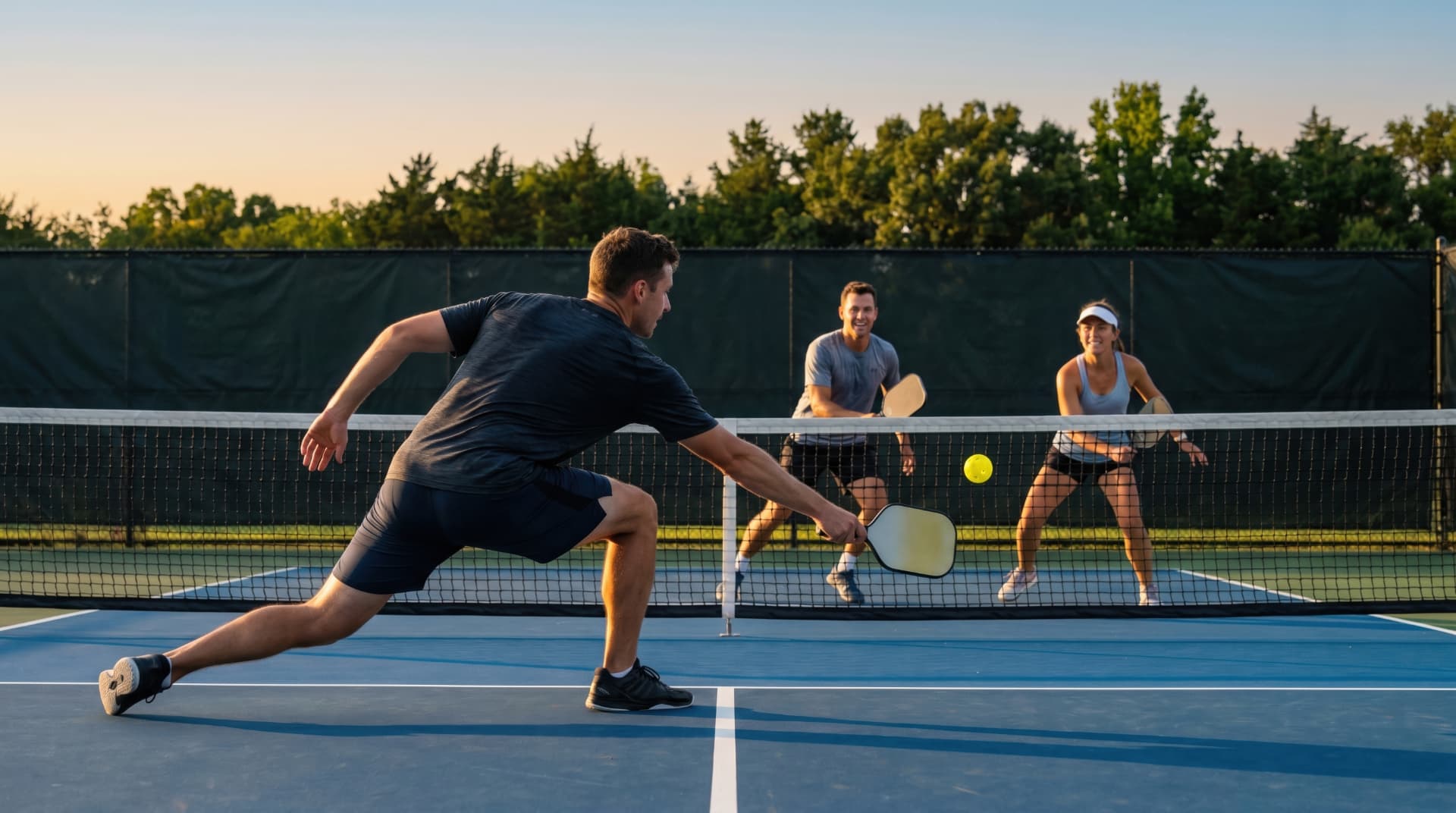
Pickleball is the fastest-growing sport in America, and the injury pattern has come with it. Five patterns account for nearly every case we see.
Pickleball has taken over Palm Beach County. Every club from Wellington to Delray Beach has added courts. New leagues fill within days. The fastest-growing sport in America is fueled largely by adults over fifty — and along with the growth has come a wave of injuries that most players don't see coming.
At Stryde, we've been treating pickleball injuries since the sport first exploded locally, and nearly every case falls into one of five patterns. If you play three or more times a week — which is most serious players in this county — knowing what to watch for is the difference between a full season and six weeks on the sideline.
1. Rotator cuff strain
What it looks like: Shoulder pain during overhead shots and serves. Often worse the day after a session. May radiate down the outside of the arm.
Why it happens: Pickleball involves more overhead loading than most players realize. The overhead smash, the serve, the reach for a lob — each one demands full shoulder range with the arm under load. Players over fifty often have subtle rotator cuff deconditioning that goes unnoticed until pickleball asks the shoulder to do things it hasn't done in years.
The fix: Progressive rotator cuff loading, not rest. Rest alone rarely resolves this pattern — the tendon needs to be rebuilt through specific loading protocols. Most cases resolve in six to ten weeks of targeted work.
Five injury patterns account for nearly every pickleball case we see over 50.
2. Achilles tendinopathy
What it looks like: Pain and stiffness in the back of the heel or lower calf, worst in the morning and after sitting for a while. Usually builds over weeks rather than appearing suddenly.
Why it happens: Pickleball involves quick starts, stops, and lateral shuffles — all of which load the Achilles heavily. Players transitioning from tennis often experience it because the movement patterns are shorter and sharper. Players new to sport in general get it because the tendon hasn't been loaded for years.
The fix: Progressive tendon loading — heavy, slow, eccentric work. The classic protocol is heel drops off a step, done daily for eight to twelve weeks. Anti-inflammatories and rest actually delay recovery in most cases.
3. Lateral ankle sprain
What it looks like: Acute pain and swelling on the outside of the ankle after a quick lateral movement or awkward step. Often happens on the non-dominant side because that's the side that gets caught out on quick direction changes.
Why it happens: Pickleball demands sudden lateral movements on a small court. Players who spent decades playing tennis are used to more time and space; pickleball asks the same movements in a fraction of the distance. The ankle gets rolled before the player can react.
The fix: Acute sprains require appropriate early management, but the more important step is what happens after: a proper ankle rehabilitation protocol that includes balance training, single-leg strength, and gradual return to lateral movements. Skipping this step is why so many first sprains become chronic instability.
4. Tennis elbow
Yes, in pickleball players. The name is misleading — the mechanism is any repetitive gripping activity, and pickleball hits the extensor tendons of the forearm hard, especially with certain paddle grips.
What it looks like: Pain on the outside of the elbow that worsens with gripping, lifting objects, and hitting shots. Often develops gradually over weeks.
Why it happens: Pickleball players often grip the paddle harder than they need to, and the shorter lever arm compared to a tennis racquet transmits more shock to the forearm. Combine that with the sheer volume of shots per session, and the extensor tendon takes on more load than it can recover from.
The fix: Progressive loading of the extensor tendons — the same protocol used for tennis elbow in tennis players. Grip strength work, forearm eccentrics, and often a slight adjustment to paddle grip size. Usually resolves in eight to twelve weeks.
5. Low back strain from lateral loading
What it looks like: Lower back pain, often on one side, that worsens with lateral movements — reaching sideways for a shot, twisting to hit a backhand. Sometimes accompanies pickleball-heavy weeks and settles with rest, then returns.
Why it happens: Pickleball involves constant asymmetric lateral loading — quick side-to-side movements, twisting shots, sudden reaches. If your core stability and hip mobility can't handle the demand, the lumbar spine takes the load.
The fix: The full fix isn't a low back protocol — it's building the lateral stability and hip mobility that pickleball demands. Side planks, single-leg work, hip rotational mobility. Address the system, and the back symptoms resolve.
The pattern behind the patterns
Notice something about all five: they're not really about pickleball. They're about players stepping into a sport that demands specific physical capacities they haven't built. Players who address the underlying capacities — rotator cuff strength, ankle stability, tendon capacity, core control, hip mobility — rarely develop any of these patterns. Players who don't, almost always do eventually.
Pickleball rewards physical preparation more than any other racquet sport, precisely because of how relentless the workload is. Three sessions a week adds up fast.
If pickleball is limiting you or you want to prevent the injuries you've seen sideline your playing partners, schedule a consultation. A performance assessment identifies which of the five patterns you're most vulnerable to — and how to prevent it before it starts.