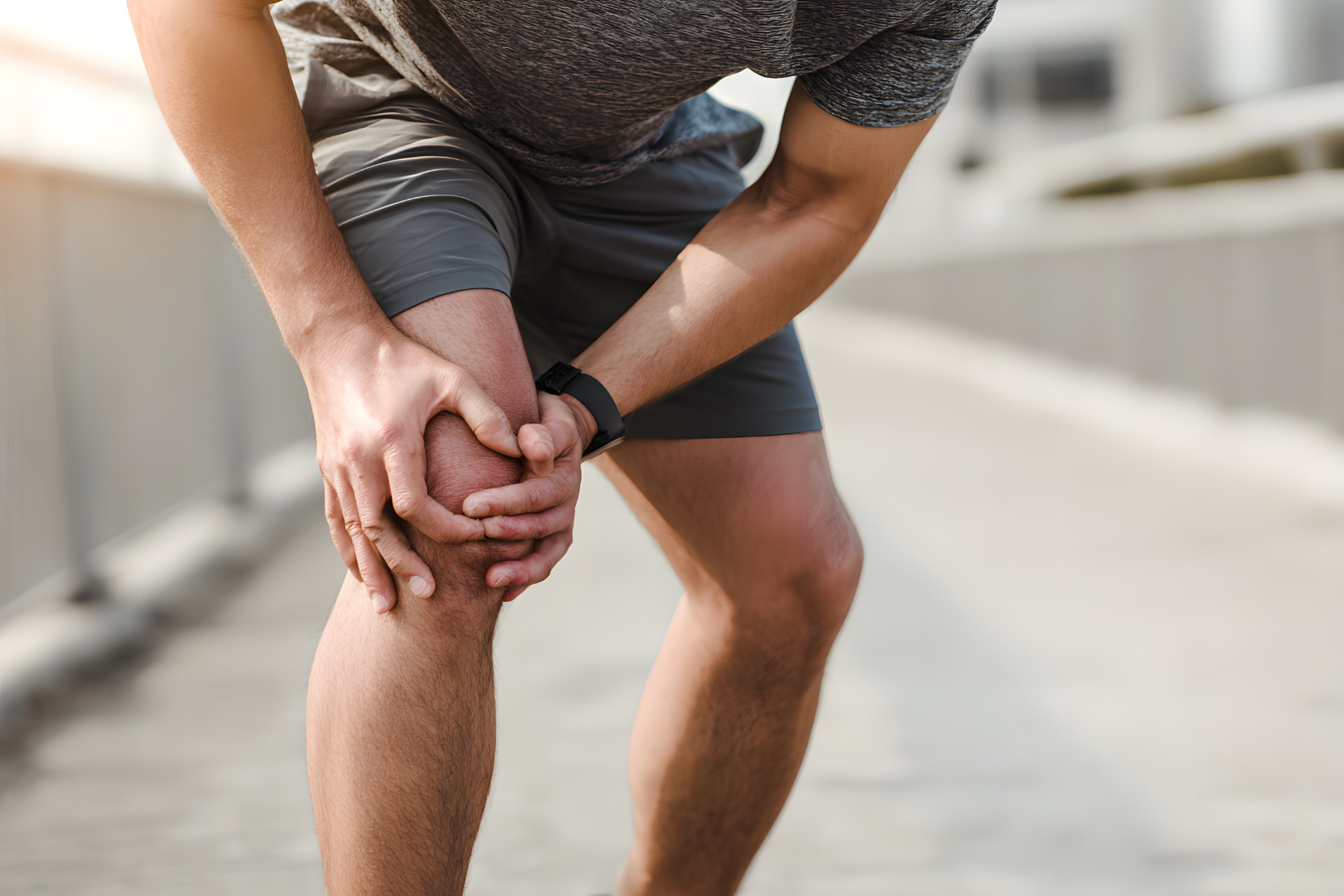
Patellar tendinopathy — jumper's knee — is one of the more stubborn tendon conditions in active adults. The treatments with actual evidence are specific, and most conservative care misses them.
Patellar tendinopathy, commonly called jumper's knee, is a chronic condition of the tendon connecting the kneecap to the shin bone. It develops most often in athletes involved in jumping and cutting sports — basketball, volleyball, tennis, pickleball — but is also common in cyclists, runners, and active adults whose sport involves repetitive knee loading.
Like other chronic tendinopathies, patellar tendinopathy responds poorly to the standard advice of rest, ice, and anti-inflammatories. Here's what the evidence supports as effective treatment.
The condition
Patellar tendinopathy is a degenerative condition of the patellar tendon, most commonly at the proximal insertion — where the tendon attaches to the bottom of the kneecap. The tendon shows disorganized collagen, failed healing responses, and often neurovascular ingrowth into tissue that shouldn't have it.
Symptoms typically include:
- Pain at the front of the knee, at the bottom of the kneecap
- Worse with jumping, deep squatting, and going down stairs
- Often develops gradually over weeks to months
- May persist for months to years without appropriate treatment
The condition was historically labeled "patellar tendonitis," implying inflammation. Current understanding is that chronic patellar tendinopathy is primarily degenerative, not inflammatory.
Why standard treatment often fails
The typical treatment cascade for patellar tendinopathy resembles other chronic tendinopathies:
- Rest, ice, stretching
- Physical therapy focused on stretching and general quadriceps strengthening
- NSAIDs
- Cortisone injection
- Referral for surgery
Rest doesn't rebuild tendon capacity. Stretching alone doesn't remodel degenerated tissue. General quadriceps strengthening isn't the specific stimulus the tendon needs. NSAIDs mask symptoms without addressing pathology. Cortisone injections in the patellar tendon are particularly concerning — associated with worse outcomes and higher rupture rates.
Patients who complete this cascade often remain symptomatic and end up considering surgery. Between the failed conservative treatments and surgical consideration, there are evidence-based approaches most patients haven't been offered.
The evidence-based treatments
The interventions with the strongest evidence for patellar tendinopathy include:
Heavy slow resistance training. This is the foundational intervention. Progressive loading of the patellar tendon with heavy, slow, controlled resistance — typically over 12 weeks or more — rebuilds tendon capacity in ways that lighter or faster training does not. Protocols like the Kongsgaard heavy slow resistance protocol have strong supporting evidence.
Eccentric decline squats. The classic Alfredson-style protocol modified for the patellar tendon uses eccentric squats on a decline board to load the tendon specifically. Effective when performed consistently.
Extracorporeal shockwave therapy. Focused shockwave has substantial evidence for chronic patellar tendinopathy that has failed conservative treatment. It stimulates tissue remodeling and often produces meaningful improvement when combined with continued loading.
Isometric loading for pain reduction. Isometric contractions of the quadriceps against resistance have been shown to reduce patellar tendon pain, sometimes acutely. Useful for managing symptoms during return to sport.
Treatments with limited or negative evidence include:
- Prolonged rest as primary treatment
- Passive treatments alone (ultrasound, ice, massage)
- Cortisone injections in the patellar tendon
- Stretching alone without loading
- General knee strengthening without tendon-specific loading
The Stryde approach to patellar tendinopathy
Treatment plans typically integrate:
Progressive tendon loading as the foundation. Heavy slow resistance training and eccentric decline squats, programmed for progression over 12 to 24 weeks.
Focused shockwave therapy for chronic cases (6+ months) or cases that have failed loading alone. Typically 3 to 6 sessions.
EMTT in cases with extensive tendon degeneration on imaging or in patients seeking accelerated healing.
Dry needling of the quadriceps and surrounding musculature contributing to the loading pattern.
Chiropractic manipulation for hip, knee, or ankle restrictions contributing to the mechanics that produced the tendinopathy.
Sport-specific movement retraining. For jumping and cutting athletes, landing mechanics and deceleration patterns often need work. For cyclists, position and pedal mechanics.
Return to sport progression guided by tendon response, typically over 8 to 16 weeks after the initial treatment phase.
The timeline
Committed treatment produces meaningful improvement in most patellar tendinopathy cases within 8 to 16 weeks. Full return to symptom-free sport typically takes 4 to 6 months. Patients need to understand upfront that this is not a fast condition to resolve — the tissue has been degenerating for months and rebuilding takes time.
Patients who abandon treatment early because they're not dramatically better in two weeks tend to remain chronic. Patients who commit to the process typically resolve.
Frequently Asked Questions
- Can I keep playing my sport during treatment?
- Modified activity is often possible, particularly with isometric loading for symptom management. Complete rest is not typically recommended for chronic tendinopathy. A supervised progression based on tendon response works best.
- How is patellar tendinopathy diagnosed?
- Clinical examination is the primary tool. Imaging (ultrasound or MRI) can confirm and quantify the pathology but isn't always necessary. Load response guides most of the useful clinical information.
- Will my patellar tendon fully heal?
- Most patients achieve symptom-free return to sport with committed treatment. The tendon tissue itself may not return to completely normal structure on imaging, but function and pain resolution are achievable.
- Is surgery ever needed?
- Rarely. The vast majority of chronic patellar tendinopathy cases resolve with appropriate combined conservative treatment. Surgery is a last resort with variable outcomes.
If patellar tendinopathy has limited your sport for more than 6 months and conventional treatment hasn't resolved it, schedule a consultation at Stryde Health and Performance in Boynton Beach. We treat chronic patellar tendinopathy with combined approaches that address the tendon tissue directly.