Shockwave therapy isn't magic, and it isn't marketing hype. It works through specific biological mechanisms that make it uniquely suited to chronic conditions.
Patients considering shockwave therapy often want to understand how it works before committing to treatment. The question is legitimate — the technology sounds vaguely futuristic, and marketing from some practices makes claims that outrun the science.
Here's the honest explanation of what actually happens during shockwave therapy and why it helps conditions that other treatments can't resolve.
The physics
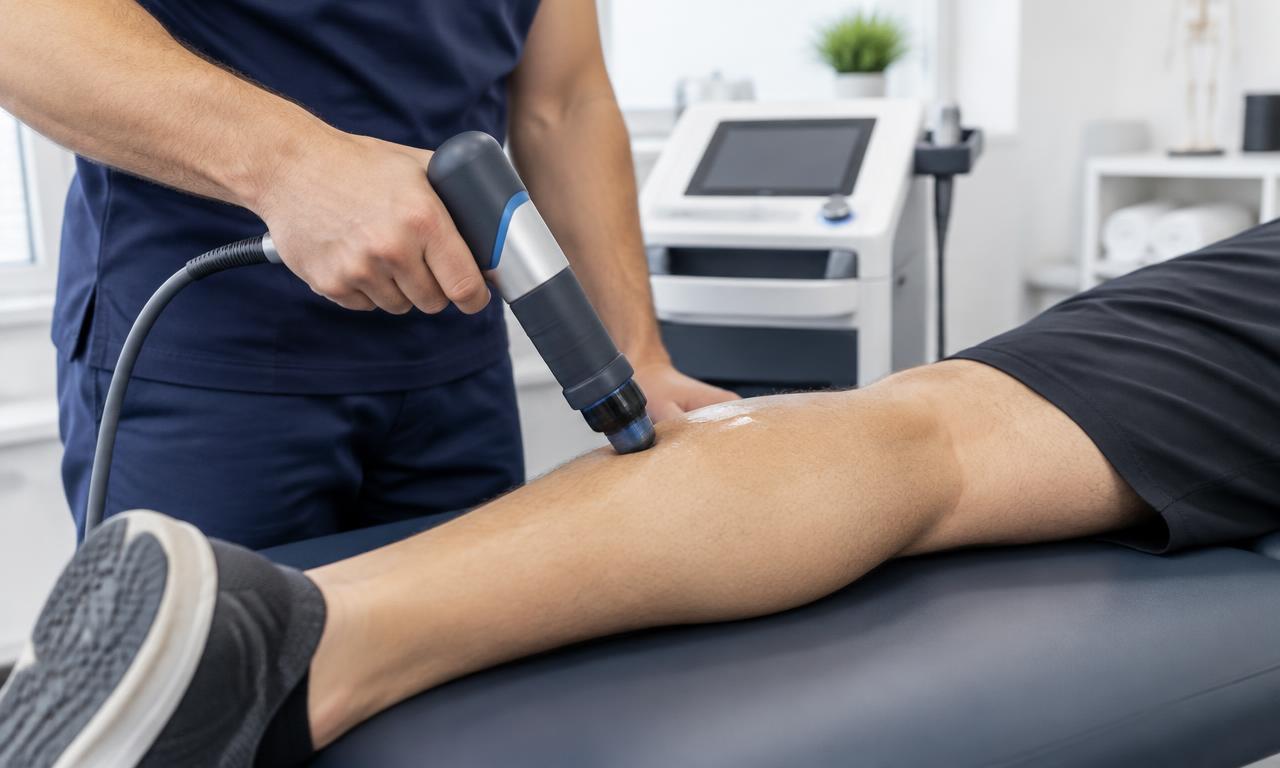
Extracorporeal shockwave therapy uses acoustic pressure waves delivered externally through an applicator placed on the skin. These waves travel through soft tissue to reach the target structure.
Focused shockwave generates high-energy pressure waves that converge at a specific focal point 3 to 12 centimeters below the skin. The energy at the focal point is high and precisely located; everything above it receives minimal energy.
Radial shockwave (technically radial pressure waves) generates energy at the skin surface that dissipates with depth. Highest at the surface, reducing within the first 2 to 4 centimeters of tissue.
Both are discrete pressure pulses — not continuous sound waves like ultrasound therapy. The pressure wave physics is what distinguishes shockwave from other acoustic modalities.
What happens in the tissue
When a shockwave reaches target tissue, several things occur simultaneously:
Mechanical stimulation of cells. The pressure wave mechanically deforms cell membranes and intracellular structures briefly. This mechanical input triggers cellular signaling cascades that would not otherwise be activated.
Mechanotransduction. Cells convert the mechanical input into biochemical signals. Specific genes are upregulated. Growth factors are released. Healing-associated proteins are produced.
Cavitation. In the fluid component of tissue, the pressure wave creates microbubbles that collapse rapidly. The collapse produces secondary shock waves that further stimulate the tissue.
Microtrauma induction. The combined mechanical effects create controlled microtrauma — damage at the microscopic level that activates healing processes.
The healing cascade that follows
The mechanical stimulation starts a biological cascade that unfolds over weeks and months:
Inflammatory phase (days 1-7). Initial inflammatory response activates immune cells and signals tissue repair processes. Patients sometimes notice increased symptoms in this phase.
Proliferative phase (weeks 1-6). New blood vessel formation (neovascularization). Fibroblast activation and collagen production. Tissue scaffolding forms.
Remodeling phase (weeks 6-24+). Collagen organizes and matures. Tissue strength and function progressively improves. This is when most symptomatic improvement occurs.
The timeline explains why shockwave results aren't immediate. The treatment initiates a process that takes months to fully develop. Patients who evaluate response at 2 weeks will be underwhelmed; those who evaluate at 12 weeks are typically the ones reporting success.
Why this helps chronic conditions
Chronic tendinopathies, plantar fasciopathy, and similar conditions involve failed healing. The tissue has started a repair process but gotten stuck — disorganized collagen, failed remodeling, abnormal neurovascular ingrowth.
Shockwave restarts the stuck healing process. By inducing controlled microtrauma and signaling a new repair response, it moves the tissue out of its chronic failed-healing state into an active remodeling state.
This is why shockwave works for conditions where anti-inflammatory treatments fail. Chronic tendinopathy isn't primarily inflammatory — it's failed healing. Suppressing inflammation doesn't help; stimulating healing does.
Why it doesn't work for everything
The mechanism explains both what shockwave can do and what it can't:
Works well for: Chronic degenerative conditions where failed healing is the primary problem. Tendinopathy, fasciopathy, calcific deposits, bone stress injuries, non-union fractures.
Works less well for: Acute inflammatory conditions, structural problems that require surgical correction (large tears, severe arthritis), and conditions where the pathology isn't primarily in the target tissue.
Patient experience during treatment
During focused shockwave, patients feel discrete pulses at the focal point. The sensation can be uncomfortable at higher energies — most describe it as a deep tapping or pulsing. No anesthesia is typically needed, and patients return to normal activity immediately.
During radial shockwave, patients feel rapid tapping on the skin surface — less deep than focused but covering a larger area. Usually well-tolerated.
Both treatments typically take 5 to 15 minutes per area treated.
Expected timeline for results
During treatment course (weeks 1-6): Some patients notice change; many don't yet. This is normal.
Weeks 6-12 post-treatment: Most improvement typically develops. Tissue remodeling is active.
Weeks 12-24 post-treatment: Final response assessment. Ongoing improvement in many cases.
Realistic expectations are important. Patients who understand the biological timeline make better treatment decisions than those expecting rapid resolution.
Frequently Asked Questions
- Is shockwave therapy the same as ultrasound?
- No. Ultrasound uses continuous low-energy sound waves primarily for tissue heating. Shockwave uses discrete high-energy pressure pulses that mechanically stimulate tissue. Different mechanisms, different applications, different results.
- How many sessions are typically needed?
- Most protocols involve 3 to 6 sessions spaced one week apart. More or fewer may be appropriate based on specific condition and response.
- Will I feel better immediately after treatment?
- Sometimes, but not typically. The real mechanism works over weeks and months. Evaluating response at the wrong time leads to incorrect conclusions about effectiveness.
- Is shockwave painful?
- Discomfort during treatment is common but typically tolerable without anesthesia. No prolonged post-treatment pain in most cases.
If you want to understand whether shockwave therapy is appropriate for your condition, schedule a consultation at Stryde Health and Performance in Boynton Beach. We offer both focused and radial shockwave therapy for appropriate conditions across Palm Beach County.