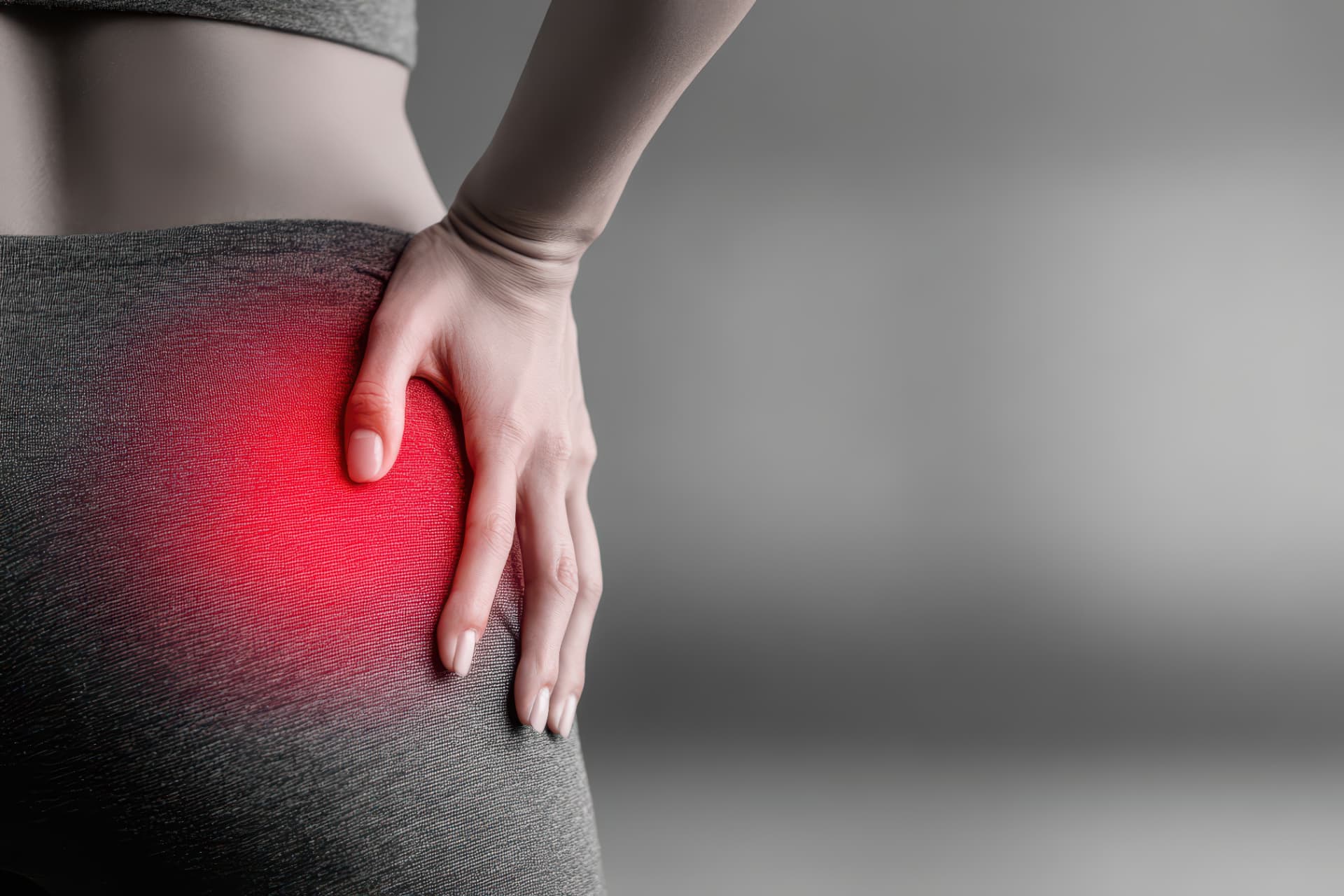
Chronic "hip bursitis" is more often gluteal tendinopathy than actual bursitis, and the treatment approach that works is different from what's typically offered.
The middle-aged patient walks in describing pain on the outside of her hip. It's been present for months. Her primary care doctor diagnosed hip bursitis and gave her a cortisone injection. It helped for a few weeks. Now it's back. She's been told to take anti-inflammatories, ice it, and consider another injection.
She probably doesn't actually have bursitis. And even if she did, the treatment approach that would produce lasting relief is different from what she's been offered.
The diagnostic problem
For decades, chronic pain on the outer hip has been labeled "trochanteric bursitis" — implying inflammation of the bursa (fluid-filled sac) overlying the greater trochanter. Current research has established that this diagnosis is usually incorrect.
The more accurate term is greater trochanteric pain syndrome (GTPS), and the primary underlying pathology in most cases is gluteal tendinopathy — specifically, degenerative changes in the tendons of the gluteus medius and gluteus minimus muscles at their attachment to the greater trochanter.
Actual bursitis — inflammation of the bursa — may occur secondarily but is rarely the primary problem in chronic cases.
This diagnostic distinction matters because bursitis (inflammatory) and tendinopathy (degenerative) require different treatment approaches. Cortisone injections make sense for bursitis and are often used for GTPS but produce inconsistent long-term outcomes because the underlying pathology is tendinopathy, not bursitis.
What actually causes GTPS
Gluteal tendinopathy at the trochanter develops from a combination of factors:
- Repetitive loading patterns that exceed tendon capacity
- Age-related tendon changes
- Weakness of the gluteal muscles leading to abnormal loading patterns
- Biomechanical issues (leg length discrepancy, pelvic mechanics, foot mechanics)
- Direct compression from sleep positions or seated positions
- Body composition changes affecting hip mechanics
The condition is more common in women, more common with age, and more common in adults who don't strength train.
Why standard treatment often fails
The typical treatment approach — rest, ice, NSAIDs, cortisone injection — addresses the assumed inflammatory pathology but doesn't remodel the actually degenerated tendon tissue.
Cortisone injections in gluteal tendinopathy can provide temporary relief but often produce worse outcomes at 6 to 12 months compared to other interventions. Rest doesn't rebuild tendon capacity. NSAIDs may impair the healing response.
Physical therapy focused on stretching often makes symptoms worse — the tendon is being compressed against the trochanter, and stretching further compresses it.
Patients cycle through these treatments for months or years without lasting resolution.
The evidence-based approach
For gluteal tendinopathy, the interventions with the strongest evidence include:
Progressive tendon loading. Specific loading exercises — starting with isometric work and progressing to heavier resistance training — rebuild tendon capacity. This is the foundational intervention.
Extracorporeal shockwave therapy. Growing evidence base for gluteal tendinopathy that has failed conservative treatment. Focused shockwave is typically used for the deep tendon insertion.
EMTT. Cellular-level support for tendon healing, particularly in extensive or slow-responding cases.
Address the compression. Modify sleep position (avoid lying on affected side, use pillows), avoid crossing legs, avoid sustained seated positions that compress the tendon.
Chiropractic and rehabilitation for hip and pelvic biomechanics contributing to the loading pattern.
Treatments with limited or negative evidence include:
- Prolonged rest as primary treatment
- Cortisone injections in chronic cases
- Aggressive stretching that compresses the tendon
- Ultrasound therapy alone
The Stryde approach for chronic GTPS
Treatment plans typically integrate:
Focused shockwave therapy for the tendon insertion at the greater trochanter. Typically 3 to 6 sessions.
Radial shockwave therapy for surrounding gluteal musculature and IT band involvement.
Progressive loading rehabilitation — starting with isometric gluteal work and progressing to single-leg strength exercises and hip abduction work with resistance.
Dry needling of gluteal, TFL, and quadratus lumborum musculature that contributes to pain patterns and dysfunctional loading.
Chiropractic manipulation of the lumbar spine, sacroiliac joints, and hip where indicated.
Activity and lifestyle modification — sleep position, sitting habits, activity patterns during the healing phase.
Return to activity progression guided by symptom response, typically over 12 to 24 weeks depending on chronicity.
Timeline expectations
Chronic gluteal tendinopathy that has been present for 6 or more months typically takes 12 to 24 weeks of committed treatment to reach meaningful resolution. Some patients respond faster; some require longer.
Patients who commit to the full protocol — including the loading exercises, activity modifications, and complete treatment course — typically achieve lasting resolution. Patients who abandon treatment early or resume aggravating activities tend to remain chronic.
Frequently Asked Questions
- Do I need an MRI to diagnose greater trochanteric pain syndrome?
- Clinical examination is typically sufficient. MRI can confirm the diagnosis and evaluate the extent of tendon changes but isn't required in most cases. Sometimes MRI is helpful to rule out other conditions or in cases with unusual features.
- Can I still exercise with hip bursitis / GTPS?
- Modified activity is important. Complete rest is not typically recommended for chronic tendinopathy. The tendon needs progressive loading. A supervised program adjusts activity based on tendon response.
- Will my hip go back to normal?
- Most patients achieve meaningful and lasting resolution with committed treatment. Complete return to pre-condition function is achievable in the majority of cases when appropriate advanced conservative care is completed.
- Is surgery ever needed for GTPS?
- Rarely. Surgical repair of gluteal tendon tears is sometimes indicated for specific presentations, but the vast majority of GTPS resolves with appropriate combined conservative care.
If chronic hip pain has been diagnosed as bursitis and standard treatment hasn't resolved it, schedule a consultation at Stryde Health and Performance in Boynton Beach. Gluteal tendinopathy is one of the conditions we treat regularly in Palm Beach County's active adult population, particularly in patients who have exhausted standard approaches.