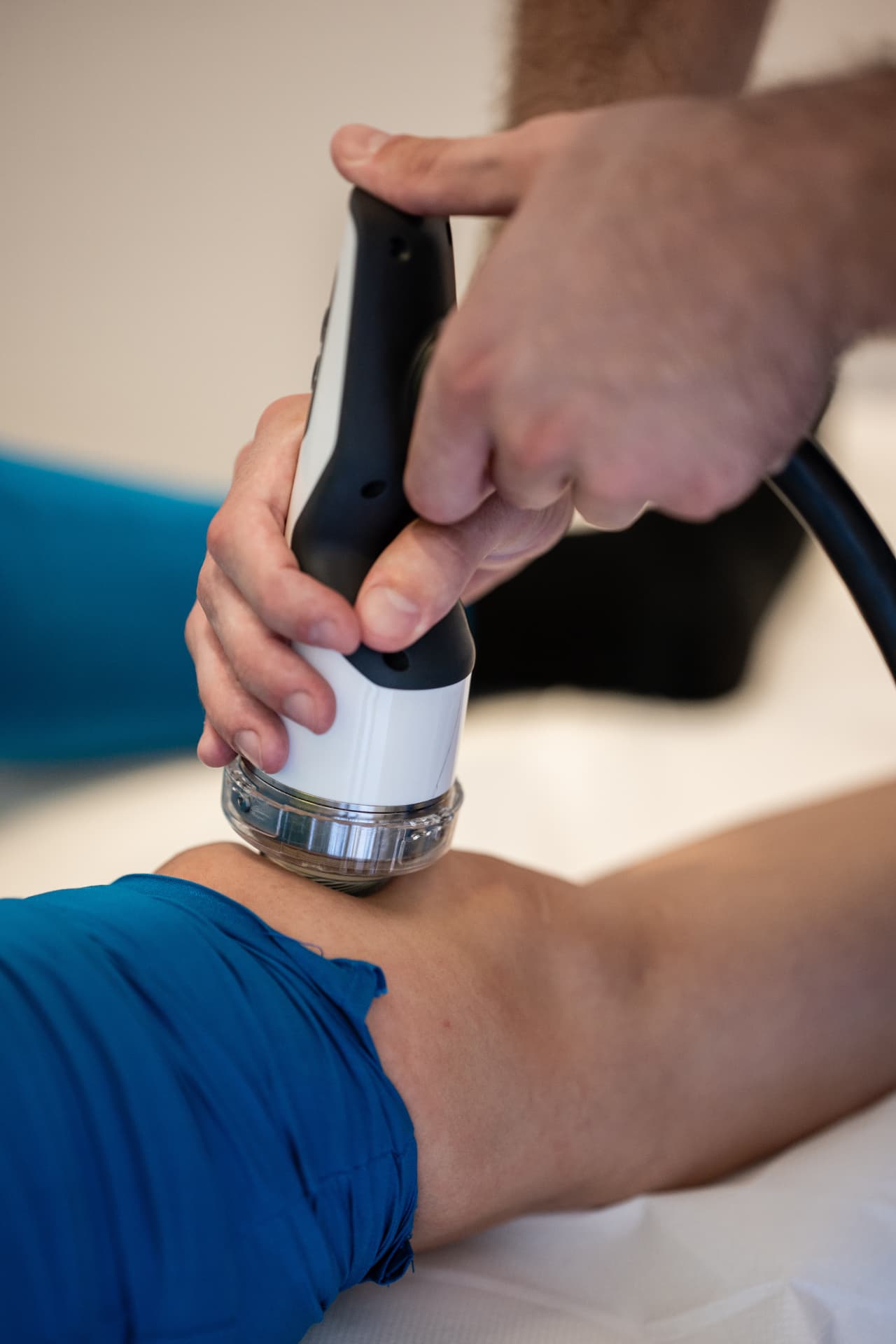
Focused and radial shockwave are often confused as the same treatment. They are not. The differences matter for the conditions each treats effectively.
If you've researched shockwave therapy for a chronic tendon issue, plantar fasciitis, or a stubborn injury that hasn't responded to conventional treatment, you've likely encountered two different terms: focused shockwave and radial shockwave — sometimes called fESWT and rESWT. Many practices offer only one. At Stryde Health and Performance in Boynton Beach, we offer both because they treat different problems in different ways.
Here's the clinical explanation of the difference.
What is focused shockwave therapy (fESWT)?
Focused extracorporeal shockwave therapy generates acoustic pressure waves that penetrate deep into tissue and converge at a specific point — the focal zone — typically 3 to 12 centimeters below the skin. The energy at the focal point is high, precise, and concentrated. Everything above the focal point receives very little energy.
Focused shockwave is FDA-approved for chronic plantar fasciitis and chronic lateral epicondylitis (tennis elbow), and it has extensive supporting evidence for calcific rotator cuff tendinopathy, chronic Achilles tendinopathy, and non-union bone fractures.
What is radial shockwave therapy (rESWT)?
Radial pressure wave therapy — technically pressure waves rather than true shockwaves — generates energy at the skin surface that dissipates rapidly as it travels inward. The energy is highest at the surface and decreases with depth, typically reaching effective levels within the first 2 to 4 centimeters of tissue.
Radial shockwave is well-established for superficial tendinopathies, muscle trigger points, and larger treatment areas where broad coverage matters more than pinpoint depth.
The critical differences
Depth of penetration. Focused reaches deep structures (hip, deep gluteal, deep hamstring origins). Radial treats superficial ones (mid-tendon, muscle bellies, plantar fascia surface).
Energy concentration. Focused delivers high energy to a small, precise point. Radial delivers moderate energy across a larger area.
Applications. Focused is preferred for deep, specific pathologies with clear anatomical targeting. Radial is preferred for broader treatment areas, trigger points, and superficial conditions.
Sensation during treatment. Focused feels like a deep, precise pulse. Radial feels like a rapid tapping or drumming on the surface.
When each is used at Stryde
Focused shockwave is our primary modality for:
- Chronic Achilles tendinopathy (mid-portion and insertional)
- Deep hip pathology (gluteal tendinopathy, greater trochanteric pain)
- Calcific rotator cuff tendinopathy
- Chronic plantar fasciitis
- Chronic patellar tendinopathy
- Non-union or delayed-union bone healing
Radial shockwave is our primary modality for:
- Myofascial trigger points across larger muscle regions
- Superficial tendinopathies (mid-Achilles, lateral epicondyle)
- Broader plantar fascia treatment
- IT band and superficial gluteal tension
- Post-injury muscle recovery
Many treatment plans combine both — focused shockwave to target the specific pathology at depth, radial shockwave to address surrounding muscle dysfunction and myofascial contributions.
What the evidence shows
Multiple systematic reviews and meta-analyses support extracorporeal shockwave therapy for chronic tendinopathies where conservative treatment (rest, physical therapy, anti-inflammatories) has failed. The International Society for Medical Shockwave Treatment (ISMST) publishes clinical guidelines for the use of both focused and radial shockwave across a wide range of musculoskeletal conditions.
For chronic plantar fasciitis specifically, focused shockwave has among the strongest evidence of any non-surgical intervention, with meta-analyses showing significant improvement in pain and function versus placebo across multiple randomized controlled trials.
Frequently Asked Questions
- How many shockwave treatments do most patients need?
- Most protocols involve 3 to 6 sessions spaced one week apart. Improvement typically becomes noticeable between weeks 4 and 12 as tissue remodeling occurs — shockwave initiates a healing response that continues developing after treatment ends.
- Is shockwave therapy painful?
- Focused shockwave can be uncomfortable at high energies, particularly on sensitive areas. Radial shockwave is typically well-tolerated. Both are done without anesthesia and patients return to normal activity immediately.
- Is shockwave therapy the same as ultrasound therapy?
- No. Ultrasound therapy delivers continuous or pulsed sound waves at very low energies, primarily for tissue heating. Shockwave therapy delivers discrete, high-energy pressure pulses that mechanically stimulate tissue repair. The mechanisms and applications are fundamentally different.
- Who is not a candidate for shockwave therapy?
- Patients with active malignancy in the treatment area, blood clotting disorders, pregnancy, and certain implants near the treatment site are generally not candidates. A clinical evaluation determines suitability.
If you have a chronic tendinopathy or musculoskeletal condition that hasn't responded to conventional treatment, schedule a consultation at Stryde Health and Performance in Boynton Beach. We offer both focused and radial shockwave therapy, and our assessment determines which — or which combination — is appropriate for your condition.