If you've had plantar fasciitis for more than six months and standard treatment hasn't resolved it, you're a candidate for a different approach — one backed by extensive research.
Plantar fasciitis is one of the most common musculoskeletal complaints in adults over 40. Most cases resolve within six months with conservative treatment — rest, stretching, orthotics, physical therapy. But somewhere between 10% and 20% of cases become chronic, persisting for a year or longer despite appropriate treatment.
At Stryde Health and Performance, chronic plantar fasciitis is one of the conditions we see most often in patients who have tried multiple providers without lasting resolution. There's a reason for that, and there's a treatment option that most primary care and orthopedic providers don't offer.
What chronic plantar fasciitis actually is
Plantar fasciitis was long understood as an inflammatory condition — hence the "-itis" suffix. Current research has shown this to be inaccurate. Chronic plantar fasciitis is more accurately termed plantar fasciopathy: a degenerative condition of the plantar fascia characterized by disorganized collagen, failed healing, and neurovascular ingrowth into tissue that shouldn't have it.
This distinction matters because it changes what treatments make sense. An inflammatory condition responds to anti-inflammatory treatment. A degenerative condition does not — anti-inflammatories may mask symptoms but do not address the underlying tissue pathology.
This is why cortisone injections often produce short-term relief followed by recurrence, and why NSAIDs help less than patients expect. The tissue itself needs to remodel, not just quiet down.
Why the standard treatments often fail chronic cases
The typical treatment cascade for plantar fasciitis looks something like this:
- Rest, ice, stretching, orthotics
- Physical therapy
- Night splints, boots, walking casts
- Cortisone injection
- Second cortisone injection
- Referral for surgical consultation
For acute plantar fasciitis (under 6 months), the early interventions often work. For chronic plantar fasciitis (over 6 months), the response rate to each of these interventions drops substantially. By the time patients are being offered surgery, they have often been dealing with the condition for years and have tried most or all of these approaches.
Surgery — plantar fascia release — has variable outcomes and carries meaningful risk, including biomechanical changes that can create new problems.
Between the failed conservative treatments and the risks of surgery, there is a treatment option with substantial evidence: extracorporeal shockwave therapy.
The evidence for shockwave therapy in chronic plantar fasciitis
Extracorporeal shockwave therapy (ESWT) has among the strongest evidence bases of any non-surgical intervention for chronic plantar fasciitis. Multiple systematic reviews and meta-analyses of randomized controlled trials support its use.
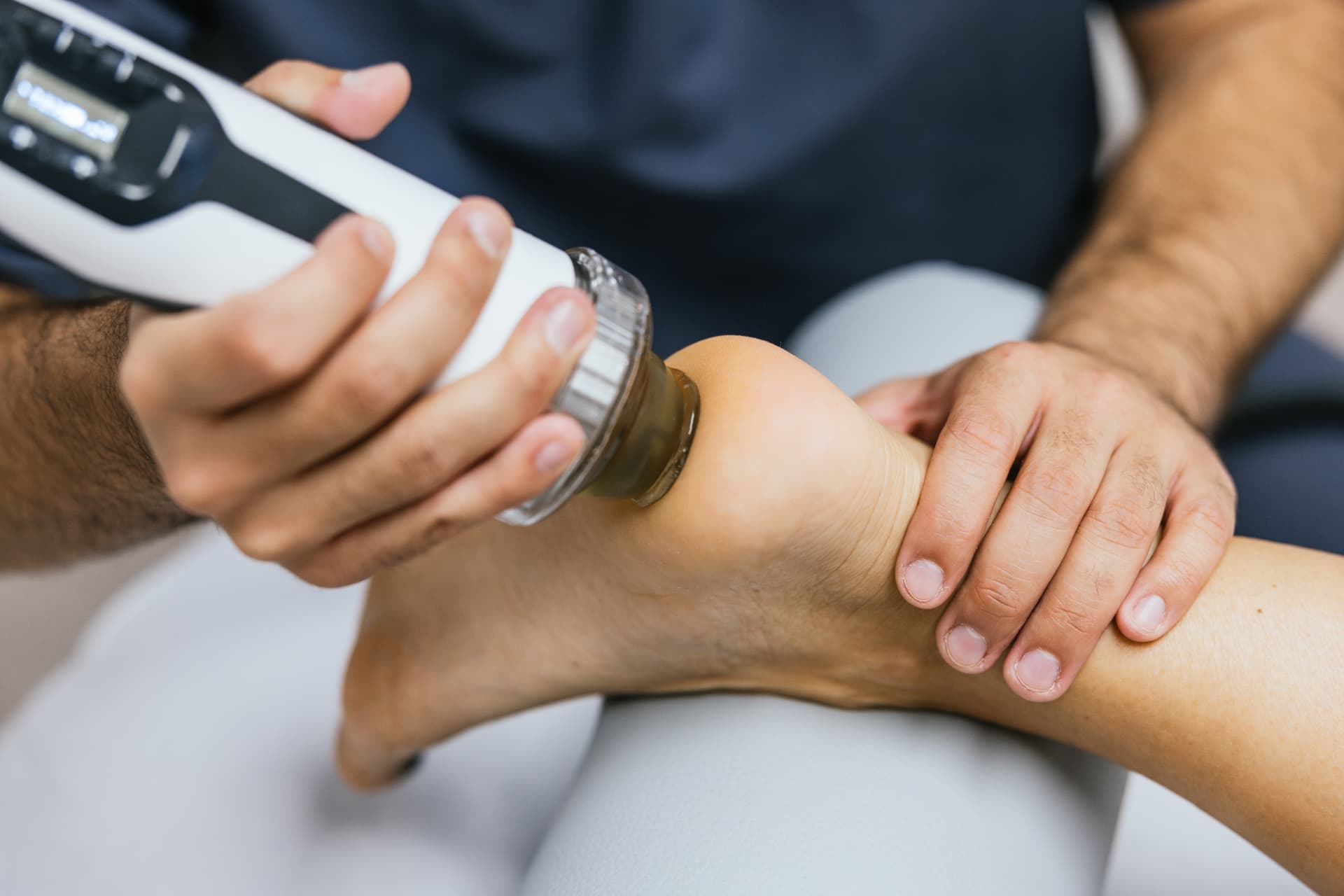
Focused shockwave therapy has been FDA-approved for chronic plantar fasciitis in the United States since 2000. Radial shockwave has also demonstrated efficacy in high-quality trials. Both work through similar mechanisms: mechanical pressure waves stimulate a healing response in the plantar fascia, initiating tissue remodeling and reducing chronic pain.
The typical protocol involves 3 to 6 sessions spaced one week apart. Improvement usually develops progressively over 8 to 16 weeks as tissue remodeling continues.
Success rates in the published literature range from 60% to 80% depending on the study, the population, and how success is defined. This is comparable to or better than most surgical outcomes, without the surgical risks.
How shockwave therapy is used at Stryde for plantar fasciitis
At Stryde Health and Performance, chronic plantar fasciitis treatment usually integrates several modalities:
Focused shockwave therapy targeting the plantar fascia origin at the calcaneus. This is the primary intervention for cases where the pathology is at the heel.
Radial shockwave therapy for broader plantar fascia treatment and often for the calf musculature, which is commonly involved in plantar fasciitis mechanics.
Rehabilitation exercise targeting calf strength and endurance, foot intrinsic muscles, and the specific loading patterns that support the plantar fascia. Progressive loading is critical for lasting resolution.
Dry needling for calf trigger points that contribute to plantar fascia tension.
Chiropractic manipulation where indicated for foot, ankle, or lower kinetic chain restrictions contributing to the problem.
The combined approach addresses the tissue directly (shockwave), the surrounding mechanics (rehabilitation and dry needling), and the broader kinetic chain (chiropractic) — which is why patients who have failed single-modality treatment often respond.
Who is a candidate
Chronic plantar fasciitis patients who benefit most from shockwave therapy typically:
- Have had symptoms for more than 6 months
- Have failed 2 to 3 conservative treatment approaches
- Have not had recent cortisone injections (a several-week washout is typically recommended)
- Have no active foot infection or other contraindications
- Are motivated to complete the treatment course and rehabilitation exercises
Frequently Asked Questions
- How is shockwave different from ultrasound therapy I received in physical therapy?
- Very different. Ultrasound therapy delivers continuous low-energy sound waves primarily for tissue heating. Shockwave delivers discrete high-energy pressure pulses that mechanically stimulate tissue remodeling. The energy levels and mechanisms are fundamentally different.
- Do I need to stop my normal activities during shockwave treatment?
- No. Patients typically continue normal activities including walking, standing at work, and light exercise. High-impact activity may be modified during the treatment course based on individual response.
- How long until I know if it's working?
- Some patients notice change within a few sessions. Most notice progressive improvement over 6 to 12 weeks after the treatment course completes. The tissue remodeling continues developing for months after treatment ends.
- What if shockwave doesn't work for me?
- The 20-40% of patients who don't respond adequately to shockwave alone may benefit from combined approaches — EMTT, more intensive rehabilitation, or in some cases advanced injectables. Surgery is a last resort with meaningful risks and is rarely necessary once appropriate advanced conservative care has been tried.
If you've been dealing with plantar fasciitis for more than six months and conventional treatment hasn't resolved it, schedule a consultation at Stryde Health and Performance in Boynton Beach. We serve patients throughout Palm Beach County who have exhausted standard treatment options for chronic foot pain.