Of all the fitness metrics researchers have studied, VO2 max is the one that most consistently predicts how the next twenty years will go.
If you had to pick a single number to represent your overall cardiovascular fitness and long-term health trajectory, VO2 max would be the leading candidate. Research going back decades has shown that VO2 max — the maximum rate at which your body can use oxygen during intense exercise — predicts mortality risk more strongly than almost any other measurable variable.
For adults over fifty, this isn't an abstraction. It's one of the most actionable health metrics available.
What VO2 max actually measures
VO2 max measures the ceiling of your aerobic capacity — how much oxygen your body can deliver to and utilize in your working muscles during maximum effort. It integrates:
- Lung function (oxygen uptake from air)
- Cardiac output (ability of your heart to pump blood)
- Blood oxygen carrying capacity
- Mitochondrial density and function in muscle tissue
- Overall metabolic efficiency
A high VO2 max means all of these systems are functioning well together. A low VO2 max means something in the chain is limiting your capacity.
Because it integrates so many systems, VO2 max captures something important about overall biological function that no single test can match.
Why it predicts longevity so strongly
Research on VO2 max and mortality is remarkably consistent:
- Each 1 MET increase in VO2 max is associated with substantial reduction in all-cause mortality risk
- The difference between low VO2 max and high VO2 max corresponds to differences in life expectancy measured in years to decades
- Low VO2 max predicts higher risk of cardiovascular disease, cancer, cognitive decline, and functional disability
- VO2 max improvements through training translate to real reductions in mortality risk
The relationship holds across age groups and remains significant even after controlling for traditional risk factors.
What good VO2 max looks like at different ages
Rough benchmarks for adults (ml/kg/min):
Men over 50: - Below 30: poor - 30-35: fair - 35-42: good - 42-50: excellent - Above 50: elite
Women over 50: - Below 25: poor - 25-30: fair - 30-36: good - 36-42: excellent - Above 42: elite
Expect modest decline with age even in healthy individuals. The decline can be dramatically slowed with appropriate training.
How to measure yours
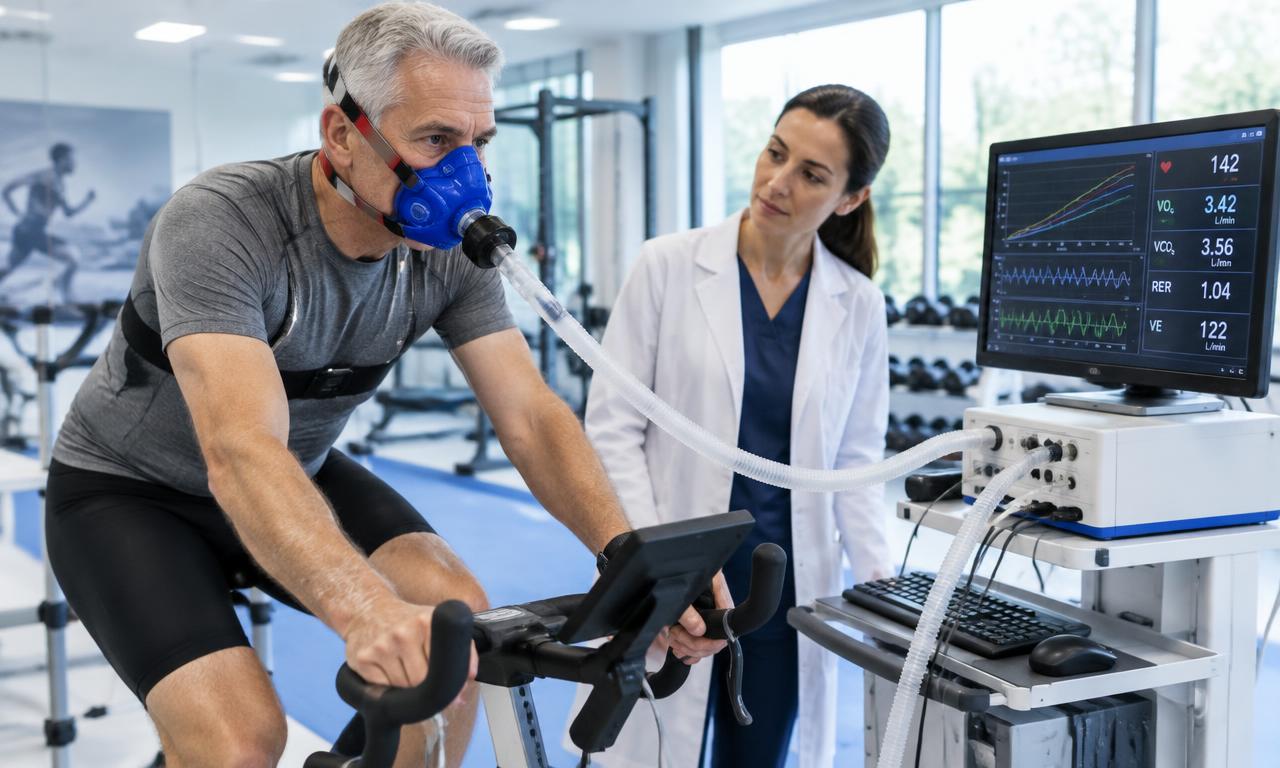
Laboratory testing is the gold standard. A VO2 max test involves progressive exercise on a treadmill or stationary bike while expired gases are measured. Available at many sports performance facilities and universities. Most accurate; typically costs $150-$300.
Estimates from wearable devices. Many smartwatches provide VO2 max estimates based on heart rate response to running or walking. Less accurate than lab testing but useful for tracking trends over time.
Field tests. The Cooper Test (how far you can run in 12 minutes) and similar field tests provide reasonable estimates and require no equipment.
For most people, directional accuracy matters more than precise numbers. Knowing whether you're high, average, or low — and whether you're trending up or down — is often sufficient.
How to improve it
VO2 max improves most with specific training approaches:
Zone 2 training. Builds the aerobic base and mitochondrial density that supports VO2 max. See Zone 2 Training for Adults Over 50 for the full protocol.
VO2 max intervals. Short, high-intensity intervals specifically targeting the VO2 max ceiling. Classic protocol: 4x4 minute intervals at 85-95% max heart rate with 3-minute recoveries. Once per week. Effective and efficient.
Longer intervals. 5-8 minute efforts at moderate-hard intensity, with equal recovery. Builds VO2 max through different mechanism than short intervals.
Volume and consistency. No single workout builds VO2 max. The adaptation comes from consistent training over months and years. Patience matters.
The training protocol that works for adults over 50
A sustainable weekly structure:
- 3 sessions of Zone 2 training (45-60 minutes each)
- 1 session of VO2 max intervals (20-30 minutes total)
- 2 sessions of strength training
- 1 day of complete rest or active recovery
This represents 5 to 8 hours of training per week and produces substantial VO2 max improvement in most adults.
Realistic expectations for improvement
Starting from sedentary or deconditioned baseline: - 10-20% improvement in VO2 max is typical in the first 6 months - 20-30% improvement is achievable over 12-18 months of consistent training - Continued improvement is possible for years, though diminishing returns set in
Starting from already-trained baseline: - Improvement is slower but still meaningful - 5-10% improvement over 12 months is a reasonable goal - Maintenance alone is valuable as VO2 max would otherwise decline with age
Frequently Asked Questions
- How often should I retest my VO2 max?
- Every 6 to 12 months is reasonable. Changes within shorter windows are hard to distinguish from day-to-day variation.
- Is VO2 max the only fitness metric that matters?
- No — strength (particularly grip strength), muscle mass, and functional capacity also predict outcomes strongly. See Grip Strength and Longevity for that angle. VO2 max is one of several important metrics.
- Can I improve VO2 max without high-intensity training?
- Zone 2 training alone produces meaningful improvement. Adding VO2 max intervals produces larger and faster improvements, but Zone 2 alone can take most adults from low to good ranges over time.
- What's a MET?
- A metabolic equivalent. 1 MET equals resting metabolic rate. VO2 max expressed in METs translates the ml/kg/min number into more intuitive terms. Each MET improvement corresponds to meaningful mortality risk reduction.
If you want to build training that improves your VO2 max and overall healthspan, schedule a consultation at Stryde Health and Performance in Boynton Beach. We build integrated training programs for active adults across Palm Beach County.